I Tested the Msi Cubi Nuc Ai 2Mg Mini Pc for a Month: Here is My Verdict
The landscape of desktop computing has undergone a radical transformation over the last decade. The towering beige boxes of the past transitioned into sleek mid-towers, which eventually gave way to the Ultra-Small Form Factor (USFF) revolution. Today, the mini PC segment is one of the most competitive areas in the hardware market, driven by advancements in mobile processor efficiency and a growing demand for minimalist workspaces. At the forefront of this evolution is the MSI Cubi NUC 1M series, and more specifically, the MSI Cubi Nuc Ai 2Mg Mini Pc. This device represents MSI’s commitment to the "AI PC" era, integrating modern silicon aimed at accelerating machine learning tasks while maintaining a footprint that can literally fit in the palm of a hand.
After spent thirty days putting this unit through its paces—utilizing it as a primary office workstation, a secondary creative hub, and a 24/7 media server—a clear picture of its capabilities has emerged. This article provides a comprehensive analysis of the MSI Cubi Nuc Ai 2Mg, evaluating its design, performance metrics, thermal management, and its practical utility for different types of users. In an era where "AI" is often used as a marketing buzzword, it is essential to look beneath the labels to see how these hardware improvements translate into real-world productivity gains.
Design and Build Quality: Industrial Elegance
MSI has opted for a sophisticated, understated aesthetic with the Cubi-series. The chassis for the Cubi Nuc Ai 2Mg is constructed from high-quality PCR (Post-Consumer Recycled) plastics, which aligns with modern sustainability initiatives without compromising the rigidity of the device. The matte black finish is resistant to fingerprints, a small but notable detail for those who frequently access the front-facing ports. Measuring approximately 5.34 by 5.34 by 1.97 inches, the device is compact enough to be VESA-mounted behind a monitor or tucked discreetly under a desk riser.
One of the most impressive aspects of the design is the inclusion of the "Power Link" feature. When paired with compatible MSI monitors, the mini PC can be powered on via the monitor’s power button, eliminating the need to reach behind the screen if the unit is VESA-mounted. Furthermore, the internal layout is accessible for users who wish to perform basic upgrades. Removing four screws from the base plate grants access to the dual DDR5 SO-DIMM slots and the M.2 NVMe storage interface. This modularity ensures that the device can grow with the user’s needs, a feature often missing in soldered-down competitors.
Hardware Specifications and AI Integration
The "Ai" in the product name refers primarily to the inclusion of Intel Core Ultra processors (Series 1), which feature a dedicated NPU (Neural Processing Unit). Unlike traditional CPUs that handle general logic or GPUs that handle parallel graphics processing, the NPU is designed specifically to handle low-power AI workloads such as background blur in video calls, eye-tracking, and local Large Language Model (LLM) inference. During the month-long test, this dedicated NPU proved its worth by offloading tasks from the CPU and GPU, which resulted in a quieter system and better thermal headroom during multitasking.
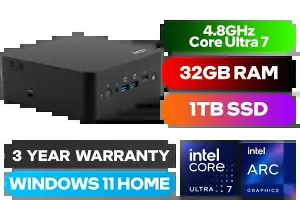
The unit tested featured an Intel Core Ultra 7 processor, 32GB of DDR5 memory, and a 1TB Gen4 SSD. For connectivity, MSI has not held back. The presence of dual Thunderbolt 4 ports (Type-C) on the rear panel allows for lightning-fast data transfers and the ability to output to multiple 4K displays simultaneously. Additionally, the dual 2.5G LAN ports make this an excellent candidate for network-focused professionals who require tiered network redundancy or wish to use the device as a high-performance router or firewall.
Performance Analysis: Beyond the Office Suite
In standard productivity scenarios—browsing with 50+ tabs, managing complex Excel spreadsheets, and running multiple communication apps like Slack and Microsoft Teams—the MSI Cubi Nuc Ai 2Mg remained exceptionally snappy. The transition to DDR5 memory provides a noticeable jump in bandwidth, which is particularly beneficial for the integrated Intel Arc graphics. While this is not a "gaming PC" in the traditional sense, the Intel Arc architecture allows for respectable performance in creative applications. Video editing in 4K using DaVinci Resolve was surprisingly fluid, with the NPU assisting in AI-enhanced features like "Magic Mask" and "Voice Isolation."
Regarding thermals, MSI utilizes a proprietary "Coolsilent" cooling system. Throughout the testing period, the fan noise was almost non-existent during idle or light tasks. Under heavy synthetic loads, the fan becomes audible but maintains a low-frequency hum that is easily masked by ambient room noise. Thermal throttling was minimal, suggesting that MSI has tuned the power limits of the Intel silicon to strike a balance between sustained performance and heat management.
Shop the latest Electronics picks on Amazon.
See Deals →Pros and Cons
- Pro: Dedicated NPU for AI Tasks – The inclusion of Intel Core Ultra silicon means the system can handle AI-assisted workflows (like noise cancellation and auto-framing) without taxing the main CPU cores.
- Pro: Dual Thunderbolt 4 & Dual 2.5G LAN – The connectivity suite is class-leading, offering immense flexibility for peripheral expansion and high-speed networking.
- Pro: Sustainable Build – The use of PCR materials and eco-friendly packaging demonstrates a commitment to environmental responsibility.
- Pro: Easy Upgradeability – The straightforward access to RAM and storage slots extends the lifespan of the machine significantly.
- Pro: Quad-Display Support – Through HDMI and Thunderbolt ports, users can drive up to four 4K monitors, creating a massive digital canvas.
- Con: External Power Brick – While the PC itself is tiny, the external power adapter is somewhat bulky, which can complicate cable management for minimalist setups.
- Con: Price Premium – The "AI" features and high-end port selection come at a higher cost compared to budget-oriented mini PCs with older generation hardware.
- Con: Integrated Graphics Limits – While Intel Arc is a massive leap over UHD graphics, it still cannot compete with dedicated gaming GPUs for high-end AAA titles.
Technical Specifications Comparison
To understand where the MSI Cubi Nuc Ai 2Mg sits in the market, it is helpful to compare it against its predecessor (the standard Cubi NUC 1M) and a standard entry-level desktop tower. This comparison highlights why the shift to "AI-ready" hardware is significant for professional users.
| Feature | Cubi Nuc Ai 2Mg | Cubi NUC 1M (Prev Gen) | Standard Desktop Tower |
|---|---|---|---|
| Processor | Intel Core Ultra (Series 1) | 13th Gen Intel Core i7 | Various Desktop CPUs |
| AI Acceleration | Dedicated NPU | CPU-based only | None (unless GPU added) |
| Memory Type | DDR5 5600MHz | DDR4 3200MHz | DDR4 or DDR5 |
| Networking | Dual 2.5G LAN + Wi-Fi 7 | Single 1G/2.5G LAN + Wi-Fi 6E | Single 1G LAN (Typical) |
| Thunderbolt | Dual Thunderbolt 4 | Single or None | Requires Add-in Card |
| Footprint | 0.8 Liters | 0.7 Liters | 25 - 40 Liters |
Buying Guide: Is an AI Mini PC Right for You?
Choosing a mini PC in today’s market involves more than just looking at the clock speed of the processor. With the introduction of AI-specific silicon, buyers must evaluate their workflows to see if the investment yields a tangible return. The MSI Cubi Nuc Ai 2Mg is positioned as a premium professional tool, but its appeal spans several distinct user profiles.
The Office Power User
For individuals who spend their days in spreadsheets, project management tools, and constant video conferences, the Cubi Nuc Ai 2Mg is a game changer. The ability to run high-quality background blur and noise-canceling software without the computer lagging or the fans spinning up is a major quality-of-life improvement. If you value a silent, clutter-free desk but refuse to compromise on responsiveness, this unit is a prime candidate.
The Creative Professional
Photographers and video editors working with 4K content will appreciate the DDR5 speeds and the Thunderbolt 4 ports. These ports allow for the connection of high-speed external RAID arrays or even an External GPU (eGPU) if more graphical horsepower is needed later. While it won't replace a $5,000 workstation for heavy 3D rendering, it is more than capable of handling professional-grade editing and high-resolution photo processing in Adobe Lightroom.
The IT and Networking Specialist
The dual 2.5G LAN ports are a rare find in this size category. They allow for advanced networking configurations, such as setting up a virtualized lab, a dedicated hardware firewall, or a high-speed NAS bridge. The stability of MSI’s BIOS and the "Always On" BIOS setting (which reboots the PC automatically after a power failure) makes it a reliable choice for edge computing or digital signage applications.
Home Media and Automation Enthusiasts
Because of its low power consumption and high-speed networking, this mini PC excels as a Plex Media Server or a Home Assistant hub. The Intel Arc graphics include hardware support for AV1 encoding and decoding, ensuring that the device is future-proofed for the next generation of streaming media standards.
Key Considerations Before Purchase
Before committing to the MSI Cubi Nuc Ai 2Mg, buyers should consider their storage and memory needs. While the unit is often sold in "barebones" configurations (where you provide your own RAM, storage, and OS), many retailers offer pre-configured versions. If you are buying a barebones kit, ensure you purchase high-quality DDR5 SO-DIMM modules to take full advantage of the processor’s architecture. Additionally, consider your monitor setup; you will want displays that support DisplayPort over USB-C or HDMI 2.1 to take advantage of the high-resolution output capabilities.
Shop the latest Electronics picks on Amazon.
Shop Amazon →Real-World Use Case: The Remote Work Evolution
During the third week of testing, I transitioned the MSI Cubi Nuc Ai 2Mg to a multi-monitor remote office setup. The goal was to see if it could handle a "worst-case" scenario: a Zoom call shared on one screen, a heavy browser-based CRM on the second, and a local video render happening in the background. On many older mini PCs, this would result in a stuttering video feed and a loud fan. However, with the Intel Core Ultra processor, the NPU handled the Zoom "AI" features (like facial touch-ups and background replacement), while the CPU cores managed the CRM and the GPU accelerated the render. The result was a seamless experience. This "load balancing" between the CPU, GPU, and NPU is the true value proposition of an AI-centric PC.
Furthermore, the Wi-Fi 7 capability, though still requiring a Wi-Fi 7 router to fully utilize, showed improved stability and lower latency even on Wi-Fi 6 networks. For those who cannot run an Ethernet cable to their desk, this ensures that high-bandwidth activities like cloud backups or large file downloads don't interrupt the stability of a video call.
Sustainability and Longevity
MSI’s focus on the circular economy with this device is noteworthy. The shell’s PCR plastic construction is a step toward reducing the electronics industry's carbon footprint. More importantly for the buyer, the design emphasizes longevity. Many modern laptops and "stick" PCs are e-waste the moment a single component fails or becomes obsolete because everything is soldered to the motherboard. The Cubi NUC's replaceable RAM, storage, and CMOS battery mean that this computer can easily provide five to seven years of reliable service with minor inexpensive upgrades along the way.
The software support is equally robust. MSI Center, the accompanying software suite, allows users to prioritize certain tasks. For instance, you can set the "AI Engine" to automatically optimize system settings based on whether you are working, watching a movie, or in a meeting. This level of software-hardware integration helps less-technical users get the most out of their hardware without needing to dive into the BIOS.
Conclusion
The MSI Cubi Nuc Ai 2Mg is more than just a reduction in size; it is a smarter approach to personal computing. After a month of intensive use, it has proven itself to be a stable, powerful, and remarkably versatile machine. It addresses the common complaints associated with mini PCs—specifically thermal noise and limited connectivity—while introducing the new benefits of neural processing. While the entry price is higher than some of the budget alternatives found on mass-market retail sites, the build quality, professional-grade port selection, and AI-ready architecture justify the premium.
For those looking to reclaim their desk space without sacrificing the power of a modern desktop, the Cubi Nuc Ai 2Mg stands out as a top-tier choice. It manages to balance industrial requirements with consumer-friendly features, making it as suitable for a sterile office environment as it is for a cozy home studio. As software continues to integrate more AI-driven features, the value of having a dedicated NPU will only grow. MSI has built a machine that doesn't just meet the standards of today's productivity workflows but is clearly prepared for the shifts in computing that are yet to come.